The Pore Files
"Those black dots on your nose aren't blackheads. Every product you've tried failed because it was treating the wrong thing."
"Those black dots on your nose aren't blackheads. Every product you've tried failed because it was treating the wrong thing."
May 2nd, 2026 at 8:42 am EDT
I checked my nose every morning for four years. Strips, vacuums, clay masks, even baking soda. Then a midnight search for what I was actually looking at changed everything. — Dana Sutton.

The FaceTime Call That Made My Stomach Drop
I caught a close-up of my nose on a FaceTime call once. The lighting was harsh, the angle was wrong, and there it was. The little dark specks scattered across my nose, magnified on a phone screen for someone else to see. I spent the rest of the call angled slightly away from the camera, pretending to listen.
That moment was the latest in a four-year ritual. I'd check my nose every single morning. Not a glance — a proper check. Different angles, different lighting, pressing close enough to the mirror that I could see every single speck. Every morning, the same thing staring back at me.
The worst part wasn't that nothing worked. The worst part was I'd started to believe the problem was me. My skin. My genes. Some people just have perfect noses, and I was not one of them. That belief cost me four years. And it was completely wrong.
Four Years Of The Same Failing Rotation
I did the whole rotation. Bioré strips every week — they'd work for maybe a day, then everything was back. So I convinced myself I just needed to be more consistent.
Then the blackhead vacuum. First time I used it, I bruised my nose. Broken capillaries along the sides. My nose looked worse for two weeks, but I kept going because at least I could see something coming out, so something must be happening.
Then the Kiehl's Rare Earth mask, because someone online said it was the only thing that actually worked. Six weeks. Not one visible difference.
Then DIY. Baking soda and lemon. My skin got worse, my nose more irritated, and I felt like an idiot.
Then just squeezing with my fingers, because at least it was free. Years of trying things, believing in them, watching them fail, and buying the next thing with slightly less hope each time.
They Aren't Blackheads. They Never Were.
At about midnight on a Tuesday, I went down a research spiral trying to understand why four years of doing the right things had produced zero results.
What I found made me sit there reading for an hour. The little dark dots on my nose were not blackheads. They had a name I'd never heard before: sebaceous filaments. Every nose has them. They're not a sign of dirty skin or clogged pores. They're just how your nose works. They produce oil constantly because that's what they're supposed to do.
A blackhead is a pore stretched and filled with debris in a way that isn't normal skin function. A sebaceous filament is your skin working perfectly. They look similar. They are completely different things.
Which means every product I'd ever bought was the headache tablet for a broken arm. The symptom looked the same. The cause was different. The fix was different.
Every Strip, Vacuum, And Mask Was The Wrong Tool
Once I understood the distinction, I got genuinely angry.
Every Bioré strip is built around the assumption that what you have is a blackhead — a hardened plug that ripping outward will dislodge. Every blackhead vacuum is built on the same logic: forcing the contents out mechanically. Every clay mask in that aisle hardens, grips, and pulls. Same mechanism. Same wrong target.
And here's the part that made me put my phone down. The forcing isn't just useless on sebaceous filaments — it's actively making them worse. Every time you tear at the pore wall, you stretch the opening wider. So the next time the pore fills with oil, the opening is bigger. So the dark dot looks darker. So next week you reach for the strip again.
It's a loop where the treatment makes the symptom return faster. And the brand selling you the treatment has zero reason to ever explain that to you.
The Clay That Works Like A Magnet
What actually works on sebaceous filaments is something that understands what they are.
Your skin's natural oil — the sebum sitting in those pores — has a positive electrical charge. It just sits there, waiting. Most clays in the skincare aisle are formulated to harden and grip. They pull through force.
But there's one specific clay that pulls through charge. Montmorillonite — a green clay with a negative ionic charge. It draws sebum out of the pore the same way a magnet draws metal filings. No scrubbing. No suction. No tearing. The oil comes out because it's attracted to the clay, not because anything is forcing it out.
And when you stop forcing the pore mechanically, the wall stops getting wider. Which means instead of the problem getting worse over time, it actually starts getting better. The pore gets to settle. That's the part nobody selling pore strips will ever tell you.
How A Negative Charge Pulls Sebum Out Quietly
There are three things working on the actual problem at the same time.
The Montmorillonite clay does the magnetic pull I just described. Its negatively-charged surface attracts the positively-charged sebum out of the pore — passive, gentle, mechanism-correct.
The second is Holy Basil — the Ayurvedic botanical also known as Tulsi. The active compound is eugenol, which quiets the NF-κB inflammatory signaling that tells your skin to overproduce oil in the first place. Less signal, less oil, less filament density over time.
The third is PHA — gluconolactone — a macromolecule too large to penetrate the skin barrier. It exfoliates the surface gently while leaving the deeper layers untouched. No sting, no flaking, no compromised barrier.
The clinical numbers back it up: in a 30-day study with 104 participants, the formula reduced blackheads and visible sebum by 55%. And 44% reported calmer, less reactive skin after a single use.
The First Time I Watched It Bubble
I bought it expecting another disappointment.
The green clay went on softer than any mask I'd used. And then, within about thirty seconds, the bubbles started. Tiny carbonated lifts forming all over my nose and cheeks.
Knowing what I now knew about how the clay worked, the fizzing wasn't just a fun visual. That was the clay doing the job — drawing sebum out through charge. The bubbles are what happens when that process is working. You can literally watch the mechanism on your face.
I rinsed it off and my nose felt clean. Not raw. Not tight. Not like I'd just fought with my face. Just clean.
I checked the mirror. Something was different but I couldn't immediately say what. It took a few uses before I understood: the dark specks weren't gone overnight, but they were visibly less dense. And more importantly, they weren't coming back as fast.
Priya's Nose Looked Different In Photos In Six Weeks
I told my friend Priya about it — she had the exact same Bioré-graveyard under her sink. Three years of strips, then the vacuum that left bruising, then the Kiehl's mask for six weeks that did nothing. Same rotation, same wrong belief about what she was treating.
By week two she noticed the specks were not coming back as fast. By week four her nose looked cleaner in photos than it had in years. By week six she had not reached for an extraction tool once. Not because she gave up — because for the first time, she was treating what her nose actually had.
The clinical work tracks the same arc. In the 30-day study, 23% of participants saw measurable improvement in pore cleanliness, 43% noticed reduced redness, and there were zero reports of stinging or tightness — every other clay mask I'd ever used had produced at least one of those side effects.
Why You Won't Find This Next To The Pore Strips
After I started using it, I went back to look for it on the usual platforms — drugstore aisles, the big beauty retailers, the search results that come up when you type "blackheads" into anything.
Couldn't find it.
Everything in the pore category was the same thing. Strips. Vacuums. Hardening clay masks. All of it built around the assumption that what you have is a blackhead. Nothing built around the actual condition most of us have.
And of course it isn't. Because if the people selling pore strips ever explained sebaceous filaments to you, you'd realize you've been buying treatments for a condition you don't have for the past four years. So they don't.
This mask sits outside that whole category. It doesn't market itself against the strips because the mechanism has nothing to do with what the strips do. Different problem, different fix. That's the whole reason it actually works.
I Added Up Four Years Of Buying The Wrong Thing
I sat down and tallied it once.
Bioré strips at roughly $9 a box, used through about a box every month for four years. The blackhead vacuum at $40 — used twice, then sat in a drawer because it bruised my nose. The Kiehl's Rare Earth mask at $30, used for six weeks with no result, then thrown away. Various exfoliators, charcoal masks, and peel-off masks I tried in between. Plus the cost of the broken capillaries on the sides of my nose, which took months to fully fade.
Several hundred dollars across four years. Solving a problem I did not actually have.
The mask I'm telling you about costs less than a single month of that rotation. And it's the only thing in the pile that's targeting the right mechanism. The rest were the wrong tool, used consistently, on the wrong problem. Cost matters. But the years matter more.
Where To Find The Holy Basil Bubble Deep Mask
Velora sells the Holy Basil Bubble Deep Mask directly through their own site — not Amazon, not Sephora, not third-party retail. The reason is formulation consistency: the montmorillonite clay's charge-active properties degrade at the wrong pH and in the presence of certain preservatives, and a short supply chain is the only way to guarantee the electrochemistry still works when it reaches you. During the Skin Reset Sale, every order ships with two jars — a full 2-month supply — for $39.99. Buy 1, Get 1 Free. The 90-day money-back guarantee covers the entire order, including empty jars. The link is below.
Two Choices In Front Of The Same Mirror
You're going to do one of two things tomorrow morning.
You'll stand at the same mirror, doing the same close-up check, looking at the same dark specks scattered across your nose. You'll either reach for whatever's in the cabinet — the same strip, the same vacuum, the same hardening mask — knowing now that none of those products were ever built for what you actually have. Or you won't.
The mirror doesn't change. What you do in front of it does.
The link is at the top and bottom of this page. The 90-day guarantee means you can try it without risk. The discount won't be there forever — these things never are.
If you've been at the same mirror doing the same thing and getting nowhere, the reason isn't that your skin is broken. The reason is that the diagnosis was wrong the whole time. You can fix that today.
I have rosacea-prone skin and every clay mask I'd ever tried left me red and tight for hours afterward. I'd basically given up on the category. Three minutes with this one, no sting, and my skin actually looks like it can breathe again. The bubbling is weirdly relaxing — you can see it working without anything pulling at your face. Six weeks in and my pores look clearer than they did at 22. I'm still in disbelief that something this gentle is doing more than the aggressive products did. — Lauren J., 38
I was skeptical after trying about ten clay masks that all promised the same thing and either burned, dried me out, or did nothing at all. Bought this one mainly because I'd just done a course of retinoids and my barrier was wrecked. First clay mask I've tolerated in over a year. No tightness, no flush, no peeling afterward. The bubbles are funny but they're not the point — the point is my skin looks calmer the next morning, not raw. I've already rebought twice. — Sarah M., 41
I used to do the close-up phone-camera check on my nose every single morning. Strips for years. The blackhead vacuum (don't buy that, by the way). Kiehl's mask. Nothing ever made any visible difference. I'd accepted I just had a 'speckled' nose. Three weeks of using this twice a week and the dark dots are visibly less dense, my nose doesn't feel scrubbed raw, and I haven't reached for a strip once. The bit that actually got me wasn't the result — it was finally understanding what I'd been looking at the whole time. — Jenna T., 34
Click the button above to see if Velora is still offering the 50% discount and free U.S. shipping on the Holy Basil Bubble Deep Mask
Treat What Your Nose Actually Has With Velora
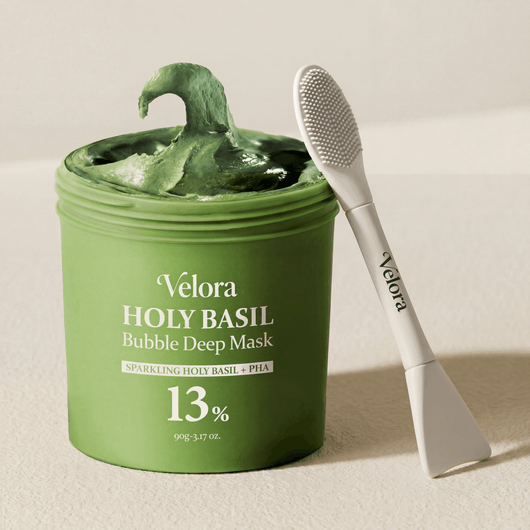
The clay built around sebaceous filaments — not the wrong diagnosis every other product on the shelf is built on
© 2026 Velora. All Rights Reserved. Privacy Policy Terms of Use
THIS IS AN ADVERTISEMENT AND NOT AN ACTUAL NEWS ARTICLE, BLOG, OR CONSUMER PROTECTION UPDATE